
Every millimeter off-line at layout becomes a meter of rework down the road. And in construction, mining, or infrastructure builds (where deadlines don’t move and budgets don’t flex), survey errors cost real money. Studies show rework can account for 5% to 20% of a project’s total value, much of it tied to inaccurate layouts and poor data capture.
Since 1999, Harper Surveying has paired field-tough GNSS gear with hands-on support, helping crews hit specs the first time.
We understand what keeps a fix under the canopy. We know how to help a crew move through dead zones. We also know what to do when your gear fails during a survey.
This guide explains how to choose the best GPS survey equipment for your site, workflow, and crew. It avoids confusing specs and sales jargon.
Why Accuracy in GPS Surveying Pays for Itself
Accuracy is the quiet moneymaker on every site.
Protects Profit Margin
More than half of project cost overruns stem from poor data and miscommunication. Precise coordinates from the start keep those overruns off the books.
Buys Time
Crews using RTK-enabled GPS survey equipment finish stake-out up to 20% faster. Tilt compensation and live corrections help remove delays in rod leveling. Faster layout means machines start grading sooner, and rental gear returns early.
Lowers Risk
Multi-band GNSS receivers perform better in tree-covered and high-reflection zones, tightening variance before inspectors ever arrive.
Powers the Workflow
Modern rovers stream verified data straight into BIM models, machine control, and as-built reports. That shared, centimeter-grade backbone keeps engineers, operators, and auditors working from a single truth.
What this all means is you pay once for precision, and earn it back in dollars saved, days gained, and headaches dodged.

GPS vs GNSS vs RTK: What Every Buyer Needs to Know
The question of GPS vs GNSS for land surveying comes up constantly, and the answer matters more than most buyers realize. Before choosing GPS survey equipment, it helps to understand what the acronyms actually mean—and why they matter on a real jobsite.
- GPS (Global Positioning System) is the U.S.-operated satellite network. It’s the system most people know. On its own, a standalone GPS delivers accuracy in the range of a few meters—adequate for navigation, but far too loose for survey-grade work.
- GNSS (Global Navigation Satellite System) is the broader term covering all satellite positioning networks: GPS (USA), GLONASS (Russia), Galileo (Europe), and BeiDou (China). A GNSS receiver tracks signals from all of these constellations simultaneously. More satellites in view means faster fixes, stronger signal geometry, and better performance under tree cover, near buildings, or in valleys where the sky is partially blocked. For land surveying, GNSS is the standard—not plain—GPS.
- RTK (Real-Time Kinematic) is a correction technique applied to GNSS. A base station—either one you set up or a network reference station—transmits corrections to your rover in real time. The rover applies those corrections on the fly, achieving centimeter-level horizontal and vertical accuracy while you’re actively collecting data. Without RTK, even the best multi-constellation receiver delivers sub-meter results at best, which doesn’t meet the tolerance requirements for boundary surveys, construction layout, or topographic work.
- Why this matters when buying: A receiver marketed as “GPS” may only track one constellation. A “GNSS receiver” tracks multiple. An “RTK GNSS rover” combines multi-constellation tracking with real-time corrections. When professionals talk about GPS for land surveying, they almost always mean RTK GPS surveying equipment, multi-constellation receivers with real-time corrections baked in. That’s the minimum standard you should be shopping for.
Key Factors When Selecting GPS Survey Equipment
Not all GPS land survey equipment is built for the realities of the field. Some hold signals through canopy and urban-canyon environments. Some lose lock when the weather shifts. If you’re sourcing high-accuracy GPS survey equipment, these are the factors that separate what works from what works against you. And the same criteria apply whether you’re buying land surveying GPS tools for a two-person crew or outfitting a full survey department.
Accuracy & Precision
If your gear can’t fix fast or hold under interference, it doesn’t belong on a jobsite. Any GNSS receiver for professional surveying should track all major constellations (GPS, GLONASS, Galileo, BeiDou)—that’s the baseline for survey-grade GNSS equipment today. Look specifically for receivers that support L1/L2/L5 frequencies—triple-band tracking reduces multipath error, the signal reflection problem that plagues single-band units near buildings and steel structures.
Also, pay attention to initialization time. The time it takes a receiver to achieve its first RTK fix affects how efficiently your crew moves from point to point. Premium units can fix in under 10 seconds. Budget units in difficult environments may take a minute or more to set up.
Durability & Field Readiness
GPS surveying equipment gets dropped, soaked, and baked. IP67+ housing, vibration resistance, and solid temperature tolerance are field requirements, not optional extras. If your receiver shuts down in a cold snap or after a rain shower, it’s dead weight. Check the operating temperature range before committing—some units struggle below -20°C, which matters on winter builds.
Ease of Use
Interfaces should get out of the way. Look for receivers that connect fast, pair with your software stack, and let your crew get to work without a 30-page manual. Some crews train in-house, and some don’t. Your gear should flex either way. Field crews with high turnover benefit most from intuitive, touchscreen-friendly workflows and a clear system
Battery Life and Power Management
Stake-out days run long. Your GPS survey equipment should, too. You want at least 10 hours of runtime in the field—more if you’re doubling shifts. Hot-swappable batteries, clean charge status, and USB-C charging keep downtime off the schedule. If a battery swap requires powering down and re-initializing the receiver, that eats time. Look for units that maintain their fix through battery swaps.
Connectivity and Data Transfer
Your GPS surveying equipment needs to talk, clearly and consistently. That means stable Bluetooth, reliable Wi-Fi, and cellular or UHF options for RTK corrections. On remote builds, a dropped signal doesn’t just delay work—it can reset the day. Units that support both UHF radio and cellular correction simultaneously give you a fallback when cell coverage runs out.
Cost-to-Value Balance
Lower-cost receivers that burn hours or lose data will pay you back in overtime, not output. Look at service history, firmware stability, and how well the unit integrates with your existing software. A receiver that doesn’t play well with your field data collector or office processing software creates hidden costs long after the sale.
Support and Warranty
The real test isn’t the first setup—it’s the first failure. Choose a supplier who picks up the phone, ships fast, and knows how to troubleshoot the gear they sell. If you’re on the clock, they should be too.
Understanding the GNSS Base and Rover System
RTK GPS survey equipment typically operates as a two-part system: a base station and a rover. Understanding how a GNSS base and rover system works together helps you buy the right setup for your workflow.
- The base station is a GNSS receiver set up over a known control point. It continuously receives satellite signals and calculates the difference between its known position and the positions reported by the satellites. That difference—the correction data—gets broadcast to the rover via UHF radio, cellular modem, or an internet-connected correction network.
- The rover is the handheld or pole-mounted unit your crew carries through the site. It receives the corrections from the base in real time and uses them to achieve centimeter-level accuracy. Without a base or correction network, the rover operates in standalone GNSS mode—accurate to the sub-meter range but not survey-grade.
- Network RTK (NRTK) removes the need to set up your own base by connecting the rover to a regional network of reference stations. Services like CORS networks, VRS (Virtual Reference Station), and commercial L-band correction services, such as Atlas, fall into this category. Network RTK simplifies operations—one person, one rover—but requires cellular coverage or satellite connectivity.
- When to set up your own base: Remote sites outside cellular coverage, jobs requiring tighter local accuracy than network services provide, or situations where you need a fully self-contained setup all call for a dedicated base-rover pair. In these cases, a UHF radio link between base and rover keeps corrections flowing regardless of cell service.
Knowing whether you need a single rover with network corrections or a full base-rover kit directly shapes your equipment budget and workflow. Some of the units reviewed below support both modes.
Top-Rated GPS Survey Equipment: 5 Field-Proven Units
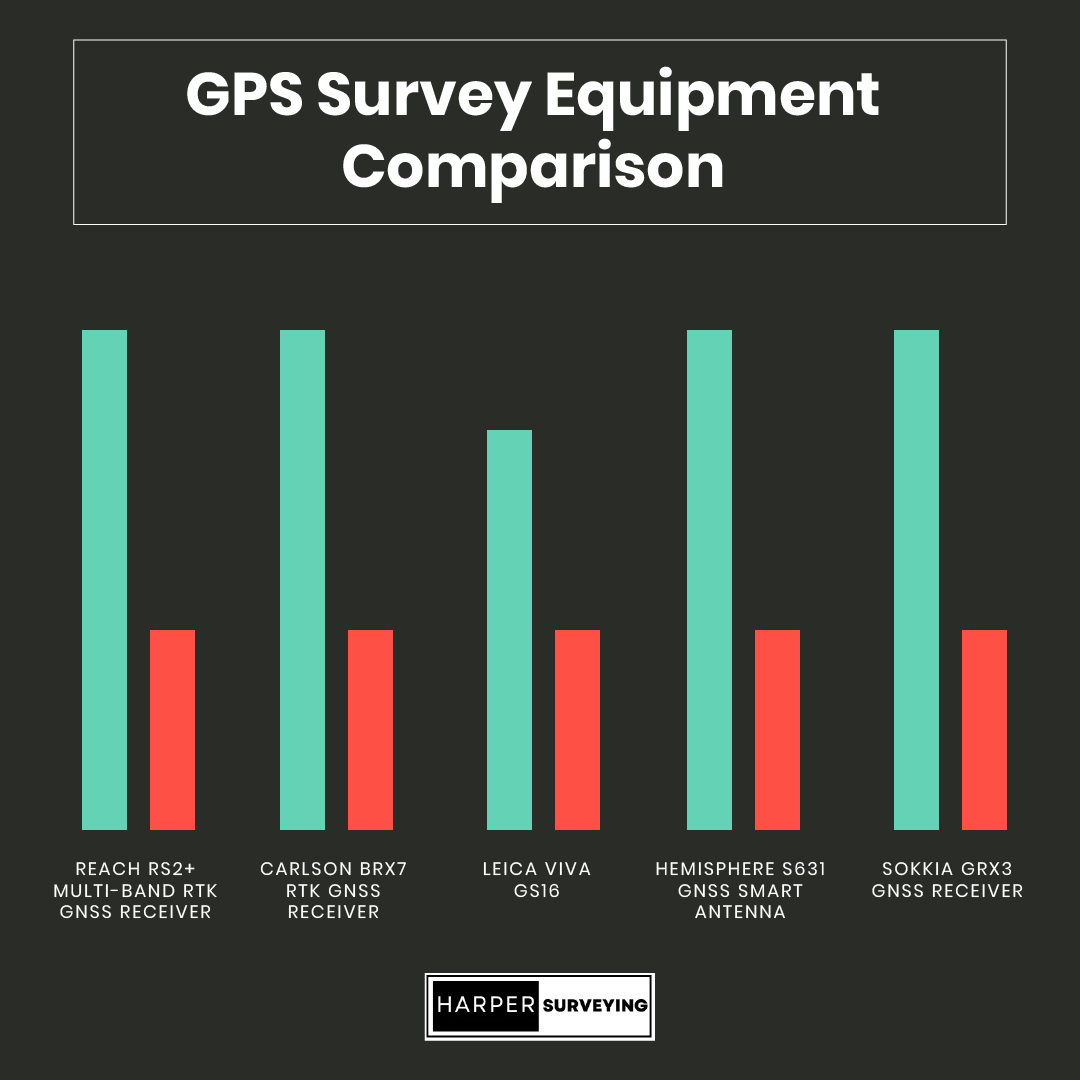
There is no shortage of GPS survey equipment, but only a few units earn their keep on jobsites. These five receivers are field-tested, crew-approved, and proven to outperform when accuracy and uptime matter most.
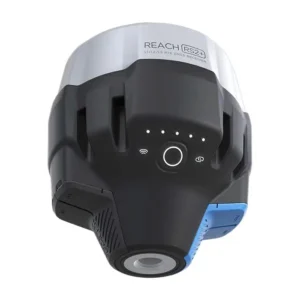
1. Reach RS2+ Multi-Band RTK GNSS Receiver
The RS2+ stands out as a reliable rover for solo crews and compact sites. Its quick fix time, multi-band accuracy, and long battery life make it great for fast turnarounds and daily use. While it doesn’t cater to enterprise-scale survey teams, it meets the core needs with solid field consistency.
Pros
- Tracks GPS, GLONASS, Galileo, BeiDou (L1/L2/L5)
- 16 hours RTK use, and 22 hours logging
- 8km LoRa baseline
- Lightweight, USB-C charging
- Pairs easily with Emlid Flow
Cons
- Fewer accessories than premium units
- Less suited to multi-crew or high-volume workflows
2. Carlson BRx7 RTK GNSS Receiver
The manufacturer designs the BRx7 GPS land survey equipment for teams working in various conditions, such as steel and trees. It combines strong multi-constellation tracking with Carlson’s workflow tools. SureFix delivers clean vectors even when satellites drop, and the 12-hour battery set swaps fast if your day runs long.
The BRx7 is not a lightweight rover. However, it is perfect for tough sites where downtime is costly. It gives up some weight in favor of reliable uptime and strong data integrity.

Pros
- Dual-frequency RTK with SureFix processing
- Holds signal in canopy and urban reflections
- Rugged IP67 housing
- Tight integration with SurvCE/SurvPC and Carlson layout tools
- Hot-swappable batteries, with up to 12 hours of runtime
Cons
- Higher price bracket
- Bulkier than compact rovers
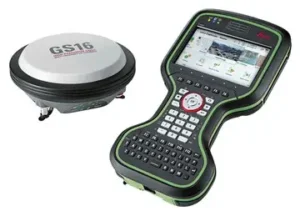
3. Leica Viva GS16
The GS16 is built for crews who bounce between wide-open cuts and steel-cluttered city blocks. Its RTKplus engine grabs a fix quickly, then defends it when satellite signals fade.
SmartLink fills the gap if network RTK cuts out, so you stay productive on remote or congested jobs. Each Li-ion pack runs for about eight hours and can be swapped without requiring a reboot. If your team wants to invest in high-quality precision, consider the Leica system. The GS16 is very reliable.
Pros
- RTKplus engine with 555-channel, multi-frequency tracking
- Self-learning algorithm adapts to the canopy and urban interference
- SmartLink satellite corrections keep fixes when cell service drops
- IP68 and MIL-STD ruggedness
Cons
- Premium price tag
- Steeper learning curve for crews new to Leica Captivate
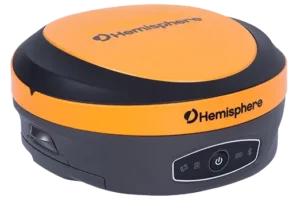
4. Hemisphere S631 GNSS Smart Antenna
Field crews like the S631 for its blend of portability and signal toughness. Athena grabs centimeter fixes fast, while Atlas keeps you in the game when cell or UHF links drop.
The web interface is helpful for teams with different devices. Any phone or tablet can change settings without a special controller.
The S631 may not match high-end units in terms of complex software systems. However, it is a great choice when you need a portable rover. It offers RTK and PPP features right out of the box.
Pros
- Athena RTK engine with multi-constellation, multi-frequency tracking
- Atlas® L-band service for sub-decimeter accuracy without a base
- Lightweight and compact for rover work
- Dual hot-swap batteries (about 12 hours combined) keep surveys rolling
- WebUI lets crews configure or troubleshoot from any browser
Cons
- Interface isn’t as intuitive as top-tier rivals
- Limited third-party accessory ecosystem
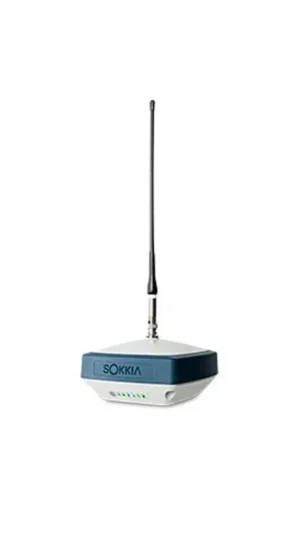
5. Sokkia GRX3 GNSS Receiver
The GRX3 is built for crews who value consistency over flash. It tracks satellites effectively and maintains a fix in light cover. Its tilt sensor helps speed up work on uneven ground, especially during topographic work in earthworks.
The GRX3 may not be as fast as newer GNSS cores. However, it is a strong choice when you need a tough rover. It works well with MAGNET workflows and continues to operate smoothly shift after shift.
Pros
- 226-channel GNSS engine; supports GPS, GLONASS, Galileo, BeiDou
- Tilt compensation up to 15 inches for slope and offset shots
- IP67-rated, drop-tested for jobsite abuse
- 12-hour hot-swappable internal battery
- Integrates cleanly with MAGNET Field and Sokkia controllers
Cons
- No onboard LTE, so it needs an external modem or controller hotspot
- Slower fix times than newer tri-band receivers
Match the Right GPS Surveying Equipment Unit to Your Industry
Every crew faces different terrain, tolerances, and workflows. A common question is: what GPS equipment do surveyors use for specific job types? Here’s where each receiver delivers most: matched by industry, not just specs.
Vertical Construction: Carlson BRx7 or Leica GS16
strong under canopy, solid signal lock near steel, and fast integration with layout and machine control tools. Both are proven GPS surveying tools for construction teams who can’t afford signal dropout mid-layout.
Mining and Exploration: Leica GS16 or Hemisphere S631
Adapts to shifting terrain. RTKplus and Atlas™ handle pit expansion and loss of cell coverage.
Manufacturing and Scrap Yards: Reach RS2+ or Sokkia GRX3
Their compact form factors and tilt shots speed layout in cluttered yards without busting budgets.
Environmental & Civil Surveys: Reach RS2+ or Hemisphere S631
Lightweight, easy to deploy, and accurate even in partial cover—ideal for sensitive zones and compliance surveys.
Tips for Maximizing Accuracy in the Field
Even the best survey GPS equipment loses value if it’s poorly set up or out of sync with the jobsite. Here’s how to get the most out of accurate GPS equipment for surveyors—whether you’re running a full RTK GPS system for land surveying or a lightweight rover on a small civil job.
- Calibrate before your first shot. Always level the pole, zero the tilt sensor, and verify the coordinate system before you start collecting data. A five-minute check before moving beats hours of rework after the fact. When setting up over a control point, double-check antenna height—every millimeter matters.
- Watch the sky. Multi-band GNSS handles partial cover well, but full canopy or dense glass curtain walls still reduce satellite geometry. Check your PDOP (Position Dilution of Precision) value before committing to critical shots. Most field software displays this in real time. A PDOP below 3.0 is ideal; above 6.0, your accuracy degrades significantly.
- Research and verify existing control. Verify local control points against known benchmarks before you start any project. Bad control is the fastest route to misaligned layouts, and it’s not a gear problem—no amount of GNSS precision rescues a job built on a bad monument. Cross-check at least two independent control points at the start of every new setup.
- Stay current on firmware. Manufacturers push updates on a monthly or quarterly basis, covering signal-tracking improvements, battery optimizations, and bug fixes. Outdated firmware can quietly degrade fix reliability, especially after satellite constellation changes. Build firmware checks into your equipment rotation schedule.
- Run field checks throughout the day. Spot-check your position against known points during long fieldwork sessions—drift happens when antennas heat up, multipath conditions shift, or correction network latency spikes. A quick cross-check every few hours costs minutes and catches problems before they corrupt a full day’s data.
- Document your setup conditions. Log antenna height, instrument used, correction source, and fix type for every session. This metadata is invaluable if coordinates need to be reviewed, audited, or defended during a dispute. Most field software captures this automatically if configured correctly.
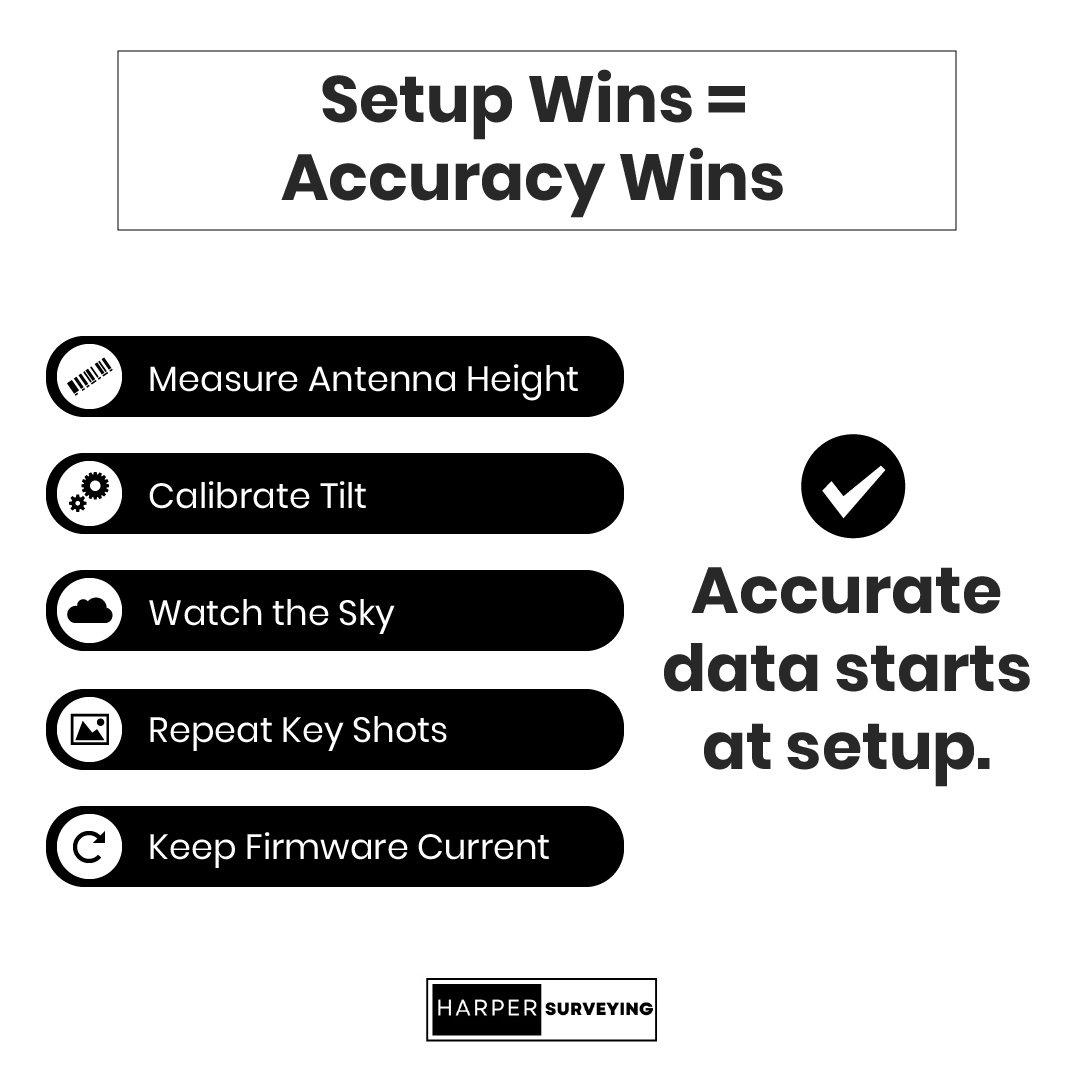
Set up right, and GPS surveying equipment will anchor your entire build to a single source of truth.
Include five steps (top to bottom):
- Measure Antenna Height
- Calibrate Tilt
- Watch the Sky
- Repeat Key Shots
- Keep Firmware Current
Harper Surveying: GPS Survey Equipment with Expert Support
When time is money, support matters as much as specs. Harper Surveying pairs every piece of GPS survey equipment with:
- Practical guidance, on demand. Live phone help during business hours and 24/7 online support from technicians who know the gear inside out.
- Same-day processing. In-stock receivers ship fast, so downtime stays off the schedule.
- Transparent pricing and solid warranties. Pro-grade gear, clear numbers, no surprise extras.
Ready to swap guesswork for guaranteed accuracy?
Explore our receiver lineup or contact us for a zero-pressure equipment fit check.
 English
 French
 German
 Spanish